GAT Guzman Applied Technologies
Work · Demo example

What the Three-Horizon review actually outputs. Worked on a mock $50M B2B SaaS.

Trillium Legal Ops, a fictional Series B vendor selling matter-management software to mid-market law firms. Seven AI bets in flight, no allocation defense, board pressure rising. Below is the artifact shape a real engagement produces: portfolio map, allocation table, named failure modes per horizon, kill list, and the language the CEO uses in the next board meeting.

See the engagement
§01

Trillium Legal Ops. $50M ARR. ~150 employees. Series B.

Vertical SaaS for mid-market law firms. Matter management, billing, intake, conflicts checking. Series B closed 18 months ago at a $280M post-money. Board includes two GP investors who have asked the CEO three quarters in a row to articulate the AI strategy. The COO has been the de facto AI sponsor; the head of product has been shipping pilots; the head of engineering has been quietly worried about eval coverage. Seven AI bets are in flight. None has a documented horizon, reach, or kill criterion. This is the company the Three-Horizon review is built for.

§02

Every active bet placed on the H1, H2, H3 grid by reach.

Three at Core, two Adjacent, two Transform. The classification surfaces what's overweight, what's missing, and which bets sit on the wrong horizon for their funding profile.

H1 · Bet 01

Contract redline copilot

Status: In production, ~120 paying firms

Draft redlines inside the existing matter workflow. Owned by the legal-ops product team. Paying back inside the core on seat expansion. The clearest H1 win in the portfolio.

H1 · Bet 02

Billing-narrative drafter

Status: Pilot, 8 firms

Generates the time-entry narratives associates currently write by hand. Pilot started 9 months ago, no production owner named. Sitting on the boundary between pilot purgatory and a clean H1 ship.

H1 · Bet 03

Conflicts-check automation

Status: Internal beta

Runs the conflicts query across the matter graph, surfaces ambiguous matches for human review. Built by one engineer in the gaps. No PM, no eval set. Real demand from firms.

H2 · Bet 04

Multi-agent matter intake

Status: Build phase, 4 engineers

Coordinator agent that triages new client matters, routes to the right specialist agent (litigation, IP, transactional), and packages the case for the intake partner. New revenue line as a premium SKU. One step out from the current matter-management product.

H2 · Bet 05

Vertical-specific contract model

Status: Research, 1 ML engineer

Fine-tuned on the firm's redline corpus, scoped to commercial real estate. Promises better redline quality than the general copilot. Demo-only today; no integration path to the production product.

H3 · Bet 06

Agentic case-strategy generator

Status: Concept, no funded team

From precedent database plus the firm's matter history, generate a litigation strategy memo a senior partner can edit. A new product line. Discussed in two board meetings, no roadmap.

H3 · Bet 07

Orchestrated deposition-prep agent

Status: Concept, executive interest only

Reads case file, generates witness questions, drafts cross-examination outlines. The CEO mentions it on every customer call. Engineering has not been asked to size it.
§03

Recommended allocation, reach, and named owner per horizon.

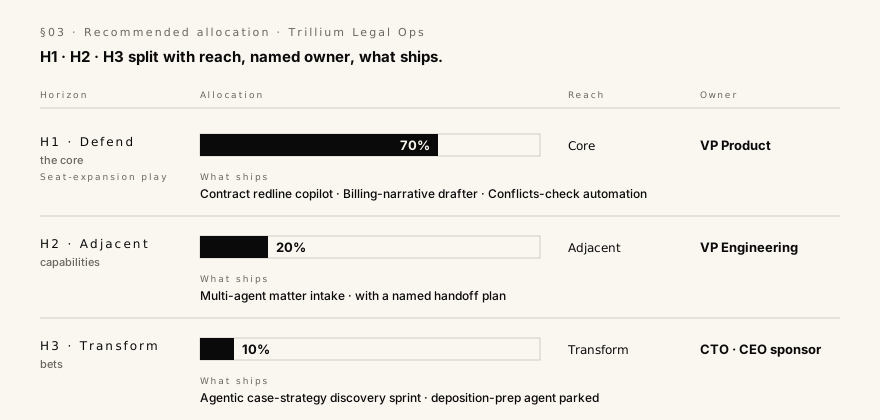
Trillium's current implicit allocation is roughly 45% H1, 45% H2, 10% H3. The review's recommended mix moves H1 up to defend the core, holds H2 at 20% with a stricter handoff plan, and frees a real budget line for H3 instead of leaving it as concept slides.

Three-Horizon AI portfolio allocation chart for mock company Trillium Legal Ops. H1 Defend the core takes 70 percent at Core reach owned by VP Product, shipping the contract redline copilot, billing-narrative drafter, and conflicts-check automation. H2 Adjacent capabilities takes 20 percent at Adjacent reach owned by VP Engineering, shipping multi-agent matter intake with a named handoff plan. H3 Transformation bets takes 10 percent at Transform reach owned by the CTO with CEO sponsorship, funding an agentic case-strategy discovery sprint with the deposition-prep agent parked. Reach measures how far the bet sits from the current operating model, not a time window.
Recommended allocation · H1 70% · H2 20% · H3 10%

H1 defends the core with three production bets at Core reach. H2 funds one capability build one step out with a named handoff plan. H3 carries one funded discovery sprint and one formally parked concept under quarterly review. The kill list (next section) removes the vertical-specific contract model.

§04

What goes wrong at Trillium if the allocation isn't defended.

Each horizon has a named failure mode that the review forces the team to flag honestly. Trillium is exposed on all three today.

H1 · Failure mode

Pilot purgatory

Billing-narrative drafter and conflicts-check automation have both lived in pilot for 9-plus months with no production owner. The H1 fix is mechanical: name a product owner, set a production date, move the bet onto the ops team's roadmap. If they don't ship this quarter, kill them.

H2 · Failure mode

Stalled handoff

Multi-agent matter intake is being built by a research-style team with no production integration path. The review forces a named handoff plan to the matter-management product team before another dollar is spent. Without it, the build ships a demo and never reaches a customer.

H3 · Failure mode

Frozen transformation

Both H3 bets have been discussed for a long stretch with no budget line and no named owner. The review unfreezes them by either funding a discovery sprint (case-strategy generator) or formally parking them with a quarterly review date (deposition-prep agent). No more vague mentions in board decks.

§05

Three bets to retire or consolidate, with rationale.

The kill list usually saves more than the engagement costs. Trillium's three calls below free a head of ML engineer, retire a vendor contract, and absorb a stalled pilot into a shipping product.

05.1 · Kill

Vertical-specific contract model

A research project with no integration path that competes for budget with the production contract redline copilot. Rationale: the general copilot covers 80% of the value at a fraction of the maintenance cost. Reassign the ML engineer to the H2 matter-intake build.

05.2 · Consolidate

Conflicts-check automation into matter-management product

An internal beta built by one engineer in the gaps. Rationale: this is an H1 ship, not a side project. Fold it under the product team that owns matter management, give it a named PM, set a production date, and ship.

05.3 · Park

Orchestrated deposition-prep agent to quarterly review

A CEO-favored concept with no engineering sizing. Rationale: park it formally on the H3 roster with a quarterly review date. The CEO can still talk about it on customer calls, but the engineering team is no longer being asked to context-switch on it ad hoc.

§06

What the CEO says in the next board meeting.

The artifact ships with the language the CEO can quote, not just charts the board has to interpret. Below: three sentences Trillium's CEO drops into the next board read-out. They neutralize the "where is our AI strategy" question without overpromising.

06.1 · Sentence

The H1 line

"We've split our AI spend across three horizons, measured by reach not time. Seventy percent defends our core matter-management revenue with three production bets."

06.2 · Sentence

The H2 line

"Twenty percent funds one Adjacent capability, multi-agent matter intake, with a named handoff plan to the product team so it ships instead of staying a demo."

06.3 · Sentence

The H3 line

"Ten percent is allocated to a single Transform discovery sprint on agentic case strategy, with the second transformation bet formally parked under a quarterly review. We will not fund H3 narrative without a discovery budget behind it."

§07

The artifact, not the engagement.

A real Trillium engagement runs four weeks: interviews with 8 to 12 team members across product, engineering, finance, and revenue, four working sessions, a board-ready memo, and the full kill-list rationale your CFO will scrutinize line by line. The page above is the shape of the output. The engagement is the work that gets you there.

Ready to talk?

Run this on your portfolio. Walk into the next board meeting with the language.

Three to four weeks. Me plus your CEO or COO plus one finance partner. Board-ready output. The kill list usually pays for the engagement on its own. I hold ~4 active client commitments across Fractional, Scoped Build, and Audit. Mix depends on what's already booked.